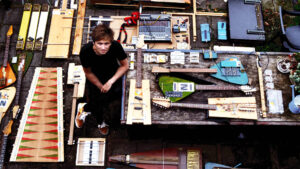
// Obi Blanche (FI) is an experimental guitarist, instrument builder, and music producer knownfor blending brutalist „béton brut“ aesthetics, somatic performance practices, and forward-thinking sonic explorations. With a creative approach deeply rooted in prepared, modified, and augmented guitars, his practice bridges DIY-inspired building methods and technologicalinnovation under #postdigitalpunk with a fellow researcher and collaborator Kristina Tica.
His diverse musical journey spans over 500 performances at venues and festivals such as All Tomorrow’s Parties London, Berghain, Boiler Room Berlin, Istanbul Jazz Festival and Lowlands, as well as collaborations with artists including Thomas Azier, Anika, Isabelle Wenzel and Yuri Landman. He has held residencies at Amplify Berlin, Callies Berlin and WORM Rotterdam. Currently pursuing an MA at Tangible Music Lab (Kunstuniversität Linz), his research project „From Prepared Guitar to Post-Digital Guitar“ explores gesture-controlledinstruments, movement sensors, and innovative sound manipulation.
// Yuri Landman (1973) is a musician and inventor of musical instruments. He achieved fame in the first decade of the 21st century by designing unique instruments for Sonic Youth, Liars, Half Japanese, Einstürzende Neubauten, Micachu and many other experimental pop musicians. From 2009 he broadened his field of work and mainly became a guest lecturer at dozens of academies throughout Europe in the field of instrument building, sound design, microtonality, history of modern instruments. Besides his career as an instrument designer he also plays live with his collection of string instruments, kalimba’s, found objects, phone mics, amped coke bottles and noise synths. Rhythmic droney noise music. Sonic Youth meets BBC Radiophonic Workshop.